🔬 Introduction
DNA profiling, also known as DNA fingerprinting, is one of the most powerful tools in forensic science for identifying individuals. It is widely used in criminal investigations, paternity disputes, disaster victim identification, and missing person cases. Unlike DNA sequencing, DNA profiling does not analyze the entire genome but focuses on highly variable regions that make every individual (except identical twins) genetically unique.

What is DNA Profiling?
DNA profiling is a forensic technique used to identify an individual by analyzing specific repetitive DNA regions, mainly Short Tandem Repeats (STRs).
In simple terms, DNA profiling answers the question:
“Whose DNA is this?”
Each person has a unique combination of STR alleles inherited from their parents, which forms their DNA profile.
Principle of DNA Profiling
The principle of DNA profiling is based on genetic polymorphism.
- Certain DNA regions contain short sequences repeated multiple times
- The number of repeats varies between individuals
- These variations are stable and heritable
- STR patterns are statistically rare in the population
Because of this variability, STR analysis provides high discrimination power.
Steps Involved in DNA Profiling
1. Sample Collection
Biological samples such as:
- Blood
- Saliva
- Semen
- Hair with root
- Bone or teeth (degraded samples)
2. DNA Extraction & Purification
DNA is isolated from cells and purified to remove:
- Proteins
- Inhibitors
- Contaminants
3. DNA Quantification
The amount of DNA is measured using Real-Time PCR to ensure:
- Sufficient DNA quantity
- Proper amplification
- Avoidance of artifacts
4. PCR Amplification of STR Loci
- Selected STR loci are amplified using PCR
- Commercial STR kits amplify 15–24 loci simultaneously
- Amelogenin marker is included for sex determination
5. Capillary Electrophoresis
- PCR products are separated based on size
- Fluorescent dyes help detect alleles
- Results are visualized as electropherograms
6. Data Analysis & Interpretation
- Peaks are converted into allele numbers
- DNA profiles are compared with reference samples
- Statistical calculations are performed
📊 Understanding a DNA Profile
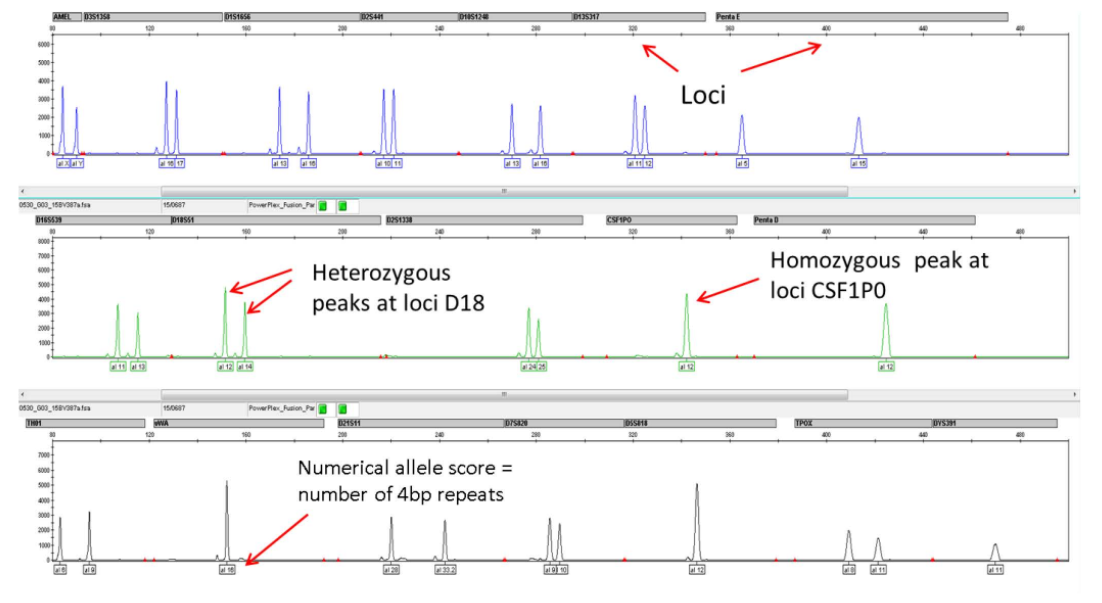
A DNA profile consists of:
- Allele numbers at each STR locus
- Homozygous (one peak)
- Heterozygous (two peaks)
- Amelogenin → XX (female), XY (male)
A match is declared only when all loci match completely.
Applications of DNA Profiling in Forensics
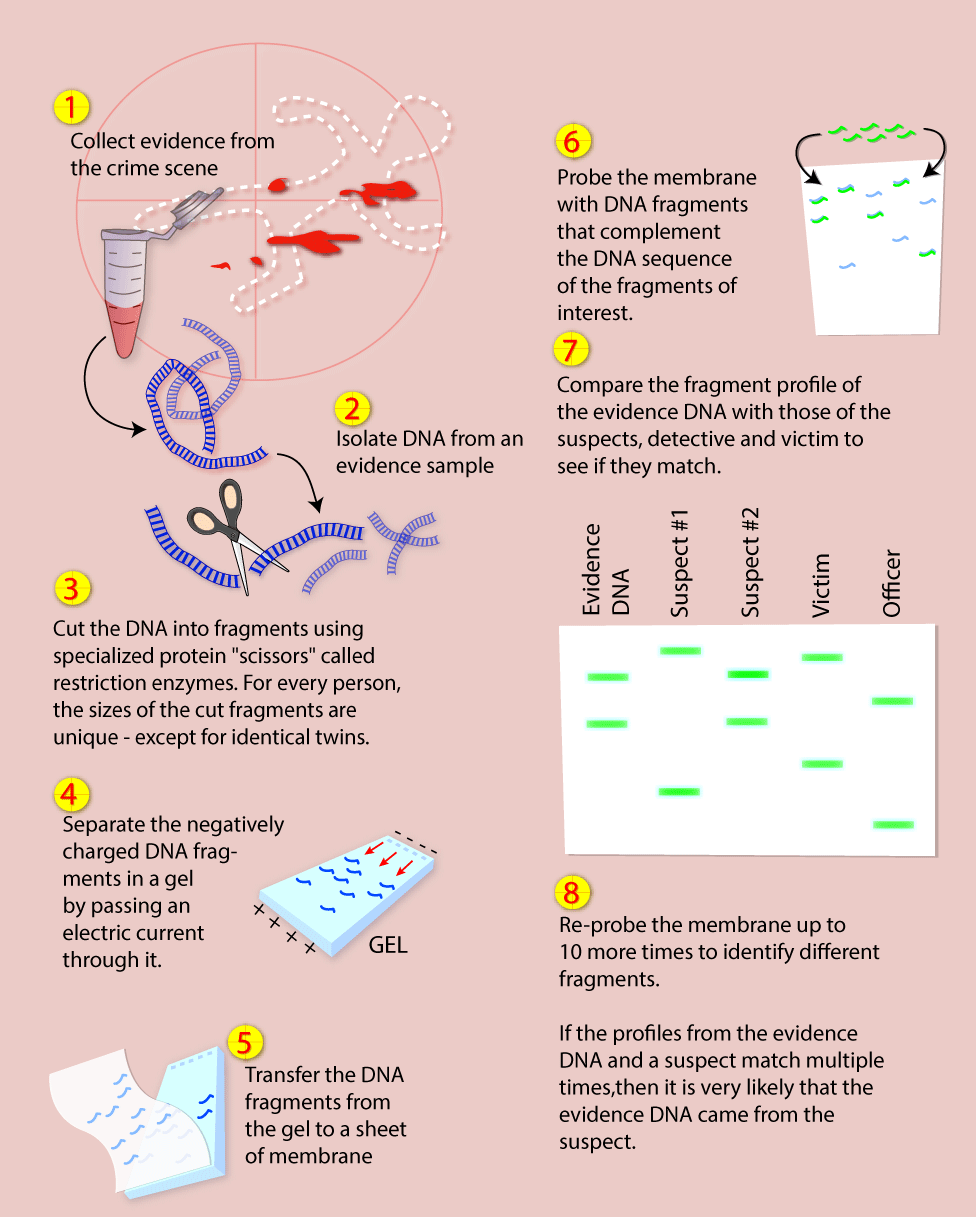
🔹 Criminal Investigations
- Linking suspect to crime scene
- Excluding innocent individuals
🔹 Paternity & Kinship Testing
- Parentage disputes
- Immigration cases
🔹 Disaster Victim Identification (DVI)
- Earthquakes
- Plane crashes
- Fires
🔹 Missing Persons Identification
- Skeletal remains
- Old unidentified bodies
🔹 Wildlife & Environmental Forensics
- Poaching cases
- Species identification
🧠 Advantages of DNA Profiling
- Highly accurate and reliable
- Works with very small DNA amounts
- Accepted worldwide in courts
- High statistical significance
- Fast and cost-effective compared to sequencing
⚠️ Limitations of DNA Profiling
- Cannot distinguish identical twins
- Degraded samples may give partial profiles
- Risk of contamination if not handled properly
- Mixture interpretation can be complex
DNA Profiling vs DNA Sequencing (Quick Comparison)
| Feature | DNA Profiling | DNA Sequencing |
|---|---|---|
| Purpose | Identification | Genetic analysis |
| DNA region | STRs only | Any DNA region |
| Output | Allele numbers | A, T, G, C sequence |
| Cost | Lower | Higher |
| Forensic routine use | ✅ Yes | ❌ Limited |
Conclusion
DNA profiling is a cornerstone of modern forensic science, providing reliable, scientifically validated evidence for human identification. Its precision, speed, and legal acceptance make it indispensable in criminal justice systems worldwide. With advancements like NGS-based STR analysis, DNA profiling continues to evolve, strengthening forensic investigations further.
Also Read : https://www.forensxbiotech.online/2025/11/dna-fingerprinting-introduction-dna.html